I read this and want to puke.
Please, somebody make this privacy service! Make it so that I can buy it.
So, the world is moving inexorably towards digital, computerized everything. (The world from from the Matrix is coming!) Well, I want a way to effectively create a blank, dummy profile in the digital world so that no marketer, no person, no corporation, no one can figure out who I am and what my preferences for anything are. LEAVE ME ALONE! My private preferences for what brand of anything I want remain a mystery to all except me.
So how would this work?
The goal is that every time I go online to do anything, including shopping at Amazon, browsing websites, my internet identity gets a random mask, but different every single time. It happens before I get onto even a supposedly secure site, like with banks and financial institution websites. Whoever is generating that mask for me doesn't know who I am because there's a double blind - two layers of masking throughout the interaction. I'm sure people are doing this already somewhere, but give me a service, or make it a law. I don't really care which because I think it's wrong to give marketers any sort of edge on me. I'm not convinced the current economic system actually works anyway.
Not using Internet services is less and less an option. Not using the internet means falling behind technologically, and unless I win the lottery, I won't be able to compete in the world without using technology. Does this piss me off? Yes.
grumble grumble grumble
Sunday, June 27, 2010

Sunday, June 13, 2010
Book Review (of sorts): The Checklist Manifesto
The Checklist Manifesto: How to get things right
By Atul Gawande
This book is a fast and easy read as Gawande writes well and engagingly. The subject of checklists and the efficacy of them is intriguing because I am highly interested in efficiencies, value, and high performance. This is the Great Trifecta, to be able to do something with minimal effort and cost, but with high reward or return. Gawande makes the case that checklists, being fundamentally low cost, are highly efficacious. The returns in various fields that he reports on all seem substantial.
The drawbacks? People don’t like to do things that seem regimented and that require discipline, which is how checklists have to be used. As Gawande writes,
“Discipline is hard – harder than trustworthiness and skill and perhaps even than selflessness. We are by nature flawed and inconstant creatures. We can’t even keep from snacking between meals. We are not built for discipline. We are built for novelty and excitement, not for careful attention to detail. Discipline is something we have to work at.”
Checklists are not just checklists. They require human adherence to them in a way that requires discipline and acceptance that we are fallible even in our most mundane, simple tasks. Gawande doesn’t really get into this so much, but beyond our dislike for disciplined, regimented action, we also don’t want to accept that many of our expectations exceed our abilities to do what needs to be done to reach those expectations. In other words, we want things to work out perfectly - or at least, very well - but to get to those expectations, we have to realize how fallible we are, how limited we actually are. Despite all the choices the modern age presents us, despite the surfeit of sophistication in the world around us, despite the technology we have, we humans are highly fallible, and our worse mistake is believe we are anything but.
I suppose age brings a certain realization that this is so, but I think as a society, we don’t like to think that all of our technology, all of our social progress, and all of our apparent intelligence does NOT bring us easier lives, but in fact, presents us with a greater need for discipline in order to match the outcomes of our actions with our expectations. Using checklists, in a way, underscores for us how fallible we are.
I gleaned a few interesting points from Gawande’s research. From the aviation industry, he discovers that checklist creation is a process. There are some important elements:
- They have to be short enough, usually one page, only, ideally 5-9 items.
- They should have pause points where people take the time to assess some condition.
- They are either DO-CONFIRM or READ-DO.
- They should focus on “killer” items only, the steps in a process that are the most critical.
- Simple and exact wording.
- Easy to read, using lowercase and uppercase, using sans serif type, like Helvetica.
- It has to get tested until it works consistently.
The last point underscores the way checklists are created at a fundamental level. They are created because of mistakes. Either people have died, or things have gone very, very badly in order that checklists needed to be made in the first place. This gives us a place to start if we wish to make our own checklists – where are the mistakes recurring? What keeps happening badly that requires we take a step back and see the flaw in the process?
It would be nice to have a checklist for life, but that one would either be longer than than day, or be fairly short. I think it might look something like this:
- Think.
- Do.
- Repeat.
Saturday, June 5, 2010
head wrap
I had hit my head recently, and the talk turned to wrapping head wounds with toilet paper.
These guys are at the Afghan peace conference. Talk about head wraps.

Omar Sobhani/Reuters
These guys are at the Afghan peace conference. Talk about head wraps.

Omar Sobhani/Reuters
Many different groups or dynasties have ruled the Afghani area. They have fun sounding names:
Greco-Bactrians, Kushans, Indo-Sassanids, Kabul Shahis, Saffarids, Samanids, Ghaznavids, Ghurids, Kartids, Timurids, Mughals, and finally the Hotaki and Durrani (off wiki-awesome-pedia).
These are the current tribes:
Pashtun
Tajik (Farsiwan, and Qezelbash)
Hazara
Uzbek
Aimak
Turkmen
Baloch
I think the two guys with the gold headwraps are Qezelbash of the Ghaznavids. (I'm making this up, I have no idea, I just like the names.)
Serious thoughts
Dean Kamen says that educated people have a responsibility to not only live prosperously, freely, enjoying the luxuries of modern, first-world existence, but because there are relatively so few educated people, we equally have a responsibility to do good in the world. If not us, then who? Because if not us, how can we expect the other half of the population that live on under $1 a day to do it for themselves? More importantly, what is your life for if you haven't done good in the world?
High standards, ambitious benchmarks.
His emotional compass is in full display when he talks about building working arms for soldiers coming home from our overseas conflicts without arms, without two arms, or without arms and without legs. A TED talk. "It's not about technology, it's about people and stories."
Tuesday, May 25, 2010
Reflection on multi-conversing
I think I've just figured out something. Many people, but mostly men with their slightly different way of relating to people than women, have issues keeping several lines of conversation going at once. On a large scale, this is obviously true. Not even I, le grande writer of this blog, can hold a conversation with more than three people, although I do enjoy the challenge. It's mostly a vision thing. I like making eye contact with people I'm talking with, and once you get more than three, you have to turn your head, and you can completely lose sight of the third person, therefore miss all the visual cues you might want.
I have found that most of the men I work with - ok, all - have a hard enough time keeping one conversation going, much less interaction with more than one. And I believe, based on my own experience, men also have issues when they can't see the person's face.
I have found that most of the men I work with - ok, all - have a hard enough time keeping one conversation going, much less interaction with more than one. And I believe, based on my own experience, men also have issues when they can't see the person's face.
Sunday, May 16, 2010
sweet potato buttermilk cornbread
I made some a few days ago, and at first, right out of the oven, I didn't think it tasted very good. It was slightly bitter, which I attribute to the sweet potato, and slightly too wet for cornbread, which I attribute to using agave nectar as opposed to granulated sugar. However, day 4 in the life of the sweet potato cornbread seems to bring it to the peak of its existence, much like a wine that needs to settle into of its flavor. Odd.
Anyway, here's what I did.
1 cup flour
1 cup Bob's Red Mill 8 Grain Cereal - good enough substitute for corn meal
3 tsp. baking powder
1 tsp. salt
1/4 cup butter
1/4 cup agave nectar
1 beaten egg
1 cup buttermilk
1-1/2 cup peeled and grated sweet potato.
Pre-heat oven to 425. Mix dry ingredients together. Cut in butter until mix is crumbly. Add wet stuff - everything else. Grease a baking dish that's at least 9x9x2 (I used a round cake pan.) Pour mix in, bake for 20-30 min. Voila!
Notes:
1 - I really enjoy cutting butter into flour. It's knowing that these small bits of butter you're embedding with flour will make tasty, greasy, buttery pockets in the final product. It really feels like you're doing something. Not unlike, say, cleaning out the basement.
2- I think the bitterness at the beginning of the life of my cornbread was perhaps because the sweet potato wasn't cooked enough. Not sure, but I would experiment in the future with grating it finer, or even pre-cooking it and just adding mashed sweet potato to the mix.
3- I sprinkled cinnamon and nutmeg on top after it was almost done baking, but definitely adding those into the mix, or at some point in the process is recommended.
4 - I feel that there is a chocolate version of this somewhere in the ether...chocolate chips, perhaps, or cocoa powder. Mmmmmmm.
Friday, May 14, 2010
Sounds!
SO, I think it's interesting how getting older has meant that my ears are more sensitive to musical nuance than ever before. I think it's an emotion thing - emotional maturity, emotional experiences, having had the chance to develop myself on an emotio-spiritual level...or something.
Anyway, sounds. Lovely sounds...
Just heard April Verch. Wow. She's cute, sings, dances, plays violin, writes songs, leads her band, teaches...and she played at the Olympics in Canada. Her legs are like John Jorgensen's fingers. A little unworldly.
John Jorgensen's "One Stolen Night" from the album of that same name has stolen my heart. I listen to it at 7am on the train, and I feel like the luckiest person in the world to be able to listen to it and see morning sun angle over the marshes of the shoreline...
April Verch's kick-ass guitar man, Clay Ross, hailing from South Carolina, has a group called Matuto. It means something in Brazilian, but I don't know what, but they have put out an album that is a mix between Brazilian music and bluegrass. And from what I'm hearing right now, it's got some funky reggae-zydeco-honkytonk-backroom blues-hint'o'grunge thing going on. Yeah! That's what I'm talking about, man! He played these awesome Brazilian shakers - they look like two small balls attached to each other by a short length of string...pickchers, need pickchers...

There. Marakas. He showed me how to play them, but it reminds me of hackey-sack - I can kick it once or twice, but to actually do something cool with it might take some effort...I think I do however have the hang of the pear shaped shaker...I need to buy one of those.

What really gets me about these people is that they are real, honest-to-god, making-a-living-as-musician musicians. And they are really amazing. And they aren't making the kind of money your average hedge fund manager is making. What, by the way, is the hedge fund manager contributing to joy and happiness in the world? Oh, well, I suppose they pay the taxes that help support unemployed people...OK. That's worthwhile.
April does this Ontario step dance thing that is pretty much tap dancing. But, my god, it's so cool...and she will sometimes play violin while tap-dancing...
OK. Enough rhapsodizing.
Thursday, May 6, 2010
Working, for now, and Good Ideas
So I started working again today after about 7 months off. I like not working better, but it was fun to do something different. Gotta keep thinking about other things to do because this job I can do already. It will bore me quickly.
I also liked this Inc. article about how good ideas don't always make it to the top. Yet, be optimistic, anyway, as a function of being human.
I also liked this Inc. article about how good ideas don't always make it to the top. Yet, be optimistic, anyway, as a function of being human.
Sunday, May 2, 2010
Humility vs. Pretention
Was thinking it was important to consider some of the things I hated about my previous job. One of them was a certain quality of pretentiousness I found myself constantly experiencing during work. Reflecting on that period is leading me to question what it is about pretention that drives people nuts, and yet, why people are drawn to positions that are almost certainly bound to lead to brushing up against a load of pretension.
I'm reviewing this article that explores humility. A few thoughts:
0. Humility in Western society seems to often be tied directly, in a knot, with Christian values. I'm not Christian, and I find it virtually impossible to view the religion without feeling a certain amount of displeasure and disgust at Christianity's sins and foibles. That discomfort with the religion makes viewing humility through that lens an avenue I will not endeavor to take.
1. For a moment, think of what pretentiousness evokes: unjustified or excessive claims of value, exaggerated importance, arrogance, pompousness, disdain, vaingloriousness, self-centeredness, to name just a few. I think the fact that there are so many words that are fundamentally about the same thing, just shades of difference, hints at how big an issue this is for us humans. The opposite word, humility, has quite fewer synonyms, two notable examples being modesty and unpretentiousness.
2. Pretentiousness is a kind of inauthenticity, an untruthfulness in essence. Pretention is a close relative of pretending, hearkening back to praetendere, meaning to stretch, extend. In our modern day world, we find people who stretch truths, extend inauthentic versions of experience to attempt to gain power, money, and quantifiable gain.
3. In our competitive society, rebellious teenagers, younger people starting in the world are told "That's just how it is." Should you try to change this status quo, you run up against brick, concrete, and crap walls. It can make a person trying to operate out of humility, or at the very least, out of a sense of authenticity that isn't about achievement, feel very lost and lonely.
4. And yet, people recognize or at least pay lip service to the idea that life's true meaning, the real worth of this experience we are all currently sharing of living, breathing, eating, crapping, sleeping, seeing beauty, seeing tragedy...the whole shebang is worth it for most people through things that deny pretentiousness. That is, true connections with others, love, service, helping others. These things, some say, are what lead to a good life, a life that when your time is up, you will be able to look back on and have no regret. And not have to lie about it to yourself.
5. Not easy questions, by far. I think of John Paulson, the hedge fund manager who, as portrayed in the book The Greatest Trade Ever. By some of society's standards, he has achieved pinnacles of success, becoming a billionaire, winning an unimaginable sum by taking advantage of systemic flaws in the social fabric. I think he's someone who was made with a drive to earn money. And so that's what he does. It's a fairly simple thing, but the milieu in which he operates is one that I cannot believe isn't oozing with pretentiousness. Can you have a moral compass amidst all that money and power?
More thoughts later.
Saturday, May 1, 2010
Music, Gongs, and Cows
Gongs are the shit. http://gongsongs.com/products.html
I love listening to gongs. Apparently, so do cows. (look for Massimo Piazza on the gongsongs page)
I love listening to gongs. Apparently, so do cows. (look for Massimo Piazza on the gongsongs page)
Friday, April 30, 2010
Spring
The days are getting gorgeous. It's really a miracle. Much better than some guy rising from the dead, pardon my insensitivity.
A couple of days ago, the rain clouds were moving off in a solid formation, and leaving behind this incredible blue sky, made all the more beautiful by the stark spring green budding out of the trees.

My photo doesn't really speak the story, but it was jaw-droppingly beautiful.
A couple of days ago, the rain clouds were moving off in a solid formation, and leaving behind this incredible blue sky, made all the more beautiful by the stark spring green budding out of the trees.

My photo doesn't really speak the story, but it was jaw-droppingly beautiful.
Thursday, April 29, 2010
WPHC - 1
This inaugurates a series of posts - that is, whenever I think of something and am inspired to post on the topic - about Why People Have Children. These are my conjectures, based in theory. Sweet, sticky, muddy, uneven, opinion-rich theory.
#1 - Some people get so intensely involved and dedicated to their work, and yet they instinctively know they'll burn out if they only focus on work. So having kids is a great way to to have a socially condoned way of saying "I can't work on this anymore, I have other responsibilities."
No judgment, just a theory.
Thursday, April 22, 2010
Thoreau and me on Cape Cod
So, I never was much of a Thoreau fan. He has always struck me as one of these faerie Victorians, with a little too much idealism. I'm pretty sure had I met in him in person, he would have annoyed me, or perhaps not. However, he is a damn good writer. I'm reading Cape Cod, his treatise on his experiences over the course of several visits in the mid-1800s. Fertile mind, his. He writes about walking across the beach from Eastham through Nauset, and of how boring it was. Giving a flavor to the kind of boredom he was experiencing, he wrote about what he read (while under an umbrella, walking along the dunes towards the coast) as he walked, that is, about the first preachers of the Outer Cape, in the 1600s. He writes about several preachers and related events for a good several pages, then ends with this wonderful sentence:
"There was no better way to make the reader realize how wide and peculiar that plain was, and how long it took to traverse it, than be inserting these extracts in the midst of my narrative."
Cape Cod is an interesting place, as much for the history that is woven into the roots of the trees and the roads and buildings running through it as for the way it reflects the current sociological fabric. The season is only just beginning to start here, and as I tour around, I see the elements clearly: the retiree, the vacationing families, the lone parent who lives out here more often than the other parent, working elsewhere. And you see the Brazilian or Portuguese landscape workers. The construction crews, natives of the fishy land. The financially well off, in their vacation uniforms of flip-flops, sunglasses, and baseball caps, the women almost always sporting a pink, green, or navy blue, slightly nautical bag. The native teenagers, doing what teenagers do everywhere in the world.
You can imagine what the construction crew guys think of the lightly clad rich woman, with her pink handbag and starfish silver jewelry. You hear the voices of those same women, concerned with either their children or their work in a shop or at some high-powered company. Surely similar socio-economic class differences play out everywhere in the US, but I think it is rather stark here on the Cape during shoulder season.
In any case, I'm enjoying my time here, with the stinky one, Bandit.

It is the Year of the Tiger, after all.
If you look up predictions about this Chinese zodiac year of the Tiger, you'll find sentences like this: "The year of the Tiger is traditionally associated with massive changes and social upheaval. Therefore, 2010 is very likely to be a volatile one both on the world scene, as well as on a personal level. "
In Tiger years, natural catastrophes frequently happen. The world seems particularly rife with large, incredible, perhaps unfortunate, events. Volcanic eruptions should be expected. Earthquakes should be expected. Just hang onto your hats, folks.
In Tiger years, natural catastrophes frequently happen. The world seems particularly rife with large, incredible, perhaps unfortunate, events. Volcanic eruptions should be expected. Earthquakes should be expected. Just hang onto your hats, folks.
Friday, April 16, 2010
Being poor, working hard
Life is not easy. It isn’t easy when you have a routine and you’re following it, and it isn’t easy when you’re in the midst of change and upheaval. It especially isn’t easy when you’re poor. You have to work so much harder than people with health and enough money for a simple, but decent life. Here’s a simple example.
Cleaning. You’re too poor to buy a proper vacuum, and the place where you rent has carpet. So you get a secondhand vacuum that probably doesn’t have great suction, and the hose attachment doesn’t work very well. (This may not be a great example for those of you who don’t believe in cleanliness.) When you vacuum, the vacuum does a so-so job of picking up stuff, and you can’t just vacuum the upholstery or anything off the floor. And the vacuum doesn’t roll easily, the pedal that lets the handle move at different angles doesn’t work properly, so you’re left lugging the heavy thing around over every little bump and lump on the floor. It’s heavy. But you have to clean - you have a child that likes to sit on the floor and play. Or you have a dog and a tick phobia…
In any case, you can’t go buy a new vacuum. You make do, you work your fingers to dry, red stubs, and get an aching back, sore limbs, fatigue, etc., making things as good as you can get them. God forbid you get sick, lose your health.
If you miss cleaning regularly, your abode gets dirty, you are more likely to get sick. Not only that, but the dingier things get, the worse you feel psychologically, the deeper into the hole you are dropping….
You wind up having to work so much harder than people with money just to climb out of the hole. As a cautionary tale, these are a few key points:
1 - Never let yourself slide so far down you have to work twice as hard to get back out.
2 - If you’re down, realize you have to work very hard to get out.
3 - It’s easier to maintain a relatively decent life than it is to live on in sickness and poverty.
The third point may be the most important one to remember. If you’re used to a cushy life, it may be hard to understand.
If you’re used to things just working, or things being done for you, it can be incredibly hard to understand that if no one’s doing things for you, you absolutely must do for yourself. You will have to work harder to get to where you were, or just stay afloat. People aren’t actually so forgiving of others being down and out. And they make assumptions about you when you are down and out that may not be true, and yet you may need those people’s help more than ever. Yet another point at which it becomes so difficult being poor.
Let me just finish by remarking on the things that people need to do better:
Sleep - a good bed, enough warmth, decent bedroom in a proper sleeping environment.
Food - good options, good knowledge of food preparation (go Jamie Oliver!!! Luv ya.) You absolutely cannot do better than you are doing if you are not eating properly.
Education - not only food education, but training in how to prioritize, think logically. What comes first, buying all organic food, or saving to buy a decent bed that stops hurting your back? The conundrums are not always easy to solve, therefore, you need your wits about you as much as possible.
Life is hard, rife with little problems, not easily solved.
Tuesday, April 6, 2010
Buying Gifts
This is a reminder for myself and others that it's easy and good to use Amazon's Wishlist to let others know what they should get you for Christmas, birthday, Easter, or whatever the occasion. It's searchable by name.
Modifying Goals
So it gets light, like, at 6 am these days. So when do I wake up? Yeah.
I think I'm only confirming my human vs. outerspace alien status when I say that I seem to be waking up earlier the older I get. Nuts. Not a teenager anymore...
So I think I need a different goal to track....there are plenty to try but the question is, to what end? Spanish? Chinese? Nature photography? One economics book per week? Hmm...at least one book a week for a year? How about that? And write about it in blog. OK, not super original, but worthy. Very worthy.
Topics to consider: economics, sustainability, psychology, history, architecture...Social sciences generally is a good, attractive idea, but given that I have a bit of a hardcore streak, I'm thinking hard science. Engineering, materials science. Hmm. Will have to mull over this. To start, however, I will plan to finish Gregory Zuckerman's "The Greatest Trade Ever" by the end of this week, and blog about it.
This habit-making business is great. I'm waking up early, walking every day, and feeding my brain regularly. I think personal networking will also be an important goal. Because as has been oft written about, people need people.
Monday, April 5, 2010
So light so early! Spring.
Was actually awake at 6am, but it seemed that it would be a mistake to actually get up that early. So, I dozed until 7:30, got up and went for my walk. In retrospect, because my walk takes almost an hour, it would be better to get up earlier and go for the walk, get it out of the way.
The WEATHER! It's so nice now! It's funny how to arrival of spring is a bit of a surprise. I mean, here I've been indoors all winter, taking my walk between my utility room to the kitchen sink and up the stairs and looping around again, feeling chilly the whole time. It's funny how it feels like suddenly, the air outside isn't cutting into my skin with a million tiny daggers the second I step outside.
It's also funny how the weather seems to change right after some big event, like a rainstorm and flood. Before the flood, it was cold. After the flood, it's warm. I suppose it sort of makes sense in a scientific way - weather fronts often bring some kind of tumultuous weather event as two air masses of different temperatures collide or move over a region.
Wanted to note a few things about Google Reader. I've been using it for a while now, and have blogs like Design*Sponge and ArchDaily, as well as some local and national news. It's really quite an excellent thing. It brings a certain milieu right to your desk, without much work. I think my earlier critique of it was the interface and relative paucity of personalization in the way the blogs are presented. This could still be improved, but I'm finding that the content greatly overshadows the formatting, fortunately for Google Reader. However, I'm not letting it go entirely. There ought to be a way to get an even cleaner interface, but with even more adjustability, per blog. Some blogs are picture blogs, some are text. You should be able to set a text blog up for optimal text reading, and the picture blog for optimal viewing of images. Perhaps some application that picks up the images out of the blog and higlights and magnifies (literally) those on your reader screen. To be able to have a flip feature would be even cooler. I should learn some animation program so I can illustrate what I'm trying to say here. But the parts are available in the world. They just haven't been strung together quite right yet.
OK, back to taxes. Almost done.
Saturday, April 3, 2010
Early morning walk
Woke up around 6:50, started in on the morning ritual of loosening up my body. It's so variable, how the body feels in the morning. Did my calisthenics, and went out for a walk to check out the ghostly mist of the morning.
Images from the neighborhood.

Flood waters haven't receded yet.


Images from the neighborhood.

Flood waters haven't receded yet.


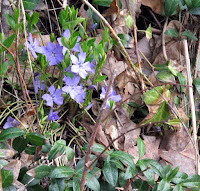
My favorite groundcover, periwinkle, vinca minor.

By the way, apparently, Bill Gates is following my example - from twitter:

Thursday, April 1, 2010
Flooding in my basement
Big rainstorm. Problems.

Tree uprooted across the street and tripped the power line circuit breaker.

My tax dollars at work.

No power, no sump pump. I had a mini waterfall in my basement.

Neighbors next street over have small waterfalls down the side of their yard.

The crapped up drainage at the corner of my yard.
Today, however, there is lots of sunshine. Perhaps even 70 degree weather!
Subscribe to:
Posts (Atom)